

When you open an online casino and browse through hundreds or even thousands of games, it is easy to assume that the casino itself created everything you see. In reality, the overwhelming majority of online casinos do not build their own games at all. They are platforms, digital storefronts that present and deliver games created by specialised software providers whose names you may never have noticed but whose work defines every second of your playing experience. Companies like Evolution Gaming, Pragmatic Play, NetEnt, Microgaming, Play’n GO, and dozens of others are the invisible architects behind the slots you spin, the tables you sit at, and the live dealer experiences that stream into your screen from professional studios around the world.
Understanding how this ecosystem works gives you a fundamentally different perspective on online gambling. It explains why the same game appears on multiple different casino platforms. It reveals why some casinos have better game selections than others. It clarifies the relationship between game quality, fairness certification, and the provider’s reputation. And it helps you make smarter decisions about which platforms deserve your time and money based on the quality of the technology partnerships they have built. This guide takes you behind the scenes of the entire process, from how a single game is conceived and built to how it reaches your screen through the complex supply chain that connects providers, aggregators, and operators in the modern iGaming ecosystem.
The Three-Layer Architecture of Online Casino Platforms
Before understanding how games are built and delivered, it is essential to grasp the structural architecture that supports every online casino. The ecosystem operates on three independent but interconnected layers, each serving a distinct function, and understanding how they fit together explains why the online casino experience works the way it does.
The first layer is the platform layer, often called the Player Account Management system or PAM. This is the casino itself, the system that handles player registration, account management, deposits, withdrawals, bonus processing, compliance, and the overall user interface. Platform providers deliver the operational infrastructure that makes a casino function as a business, including back-office tools for managing players, reporting systems for tracking revenue, and compliance modules for meeting regulatory requirements. Think of this as the building that houses the casino.
The second layer is the content layer, which is where the games live. Game providers, also called content suppliers or game studios, create the actual games that players interact with. Each provider maintains its own portfolio of titles, its own development team, its own art and sound departments, and its own certification and testing processes. A single online casino might host games from 30, 50, or even 100 different providers, each contributing their unique style, mechanics, and quality standards to the overall library.
The third layer is the aggregation layer, which connects providers to operators through a single integration point. Game aggregators act as intermediaries that bundle hundreds of game titles from multiple providers into a unified API that operators can integrate once and immediately access an entire catalogue of content. Without aggregators, each operator would need to build a separate technical integration with every individual provider, which would be prohibitively expensive and time-consuming for most businesses.
| Ecosystem Layer | What It Does | Key Players in 2026 | Role in Player Experience |
|---|---|---|---|
| Platform (PAM) | Manages accounts, payments, compliance, and operations | SOFTSWISS, EveryMatrix, Aspire Global, GammaStack | Determines registration flow, payment speed, and overall UX |
| Content (Game Providers) | Creates the actual games players interact with | Evolution, Pragmatic Play, NetEnt, Play’n GO, Microgaming | Determines game quality, variety, fairness, and entertainment value |
| Aggregation | Connects providers to operators through unified API | SOFTSWISS Game Aggregator, SoftGamings, EveryMatrix | Determines how many providers and games an operator can offer |
By keeping these three layers distinct, operators avoid vendor lock-in, simplify scaling, and can change content producers without rebuilding their underlying system. A casino can switch platform providers, add new game suppliers, or change aggregators without the entire operation needing to be reconstructed from scratch.
How a Casino Game Is Built From Concept to Launch
The creation of a single online casino game is a multi-stage process that typically takes between three and twelve months depending on the complexity of the title. It begins with ideation and ends with deployment to operator platforms, with rigorous testing and certification at every stage in between.
The concept phase starts with market research and creative brainstorming. Game designers analyse player behaviour data, trending themes, competitor releases, and market gaps to identify opportunities for new titles. A game concept document is created that defines the theme, visual style, mathematical model, bonus features, target volatility, and intended RTP. For a major studio like Pragmatic Play or NetEnt, this document goes through multiple rounds of internal review before a title is approved for development.
The mathematics phase is where the game’s core identity is established. Game mathematicians design the paytable, the symbol distribution, the win frequency, the bonus trigger rates, and the overall mathematical model that determines how the game will behave over millions of spins. This is the most critical phase of development because the mathematical model defines the RTP, the volatility, the hit frequency, and the maximum win potential, essentially every number that matters to both the player experience and the operator’s margin. The model is simulated extensively, often running billions of virtual spins, to verify that the theoretical numbers hold true under real-world conditions.
The art and animation phase brings the mathematical skeleton to life. Artists create the visual assets including symbol designs, background environments, character illustrations, and animated sequences for wins, bonus triggers, and special features. In 2026, the standard for visual quality in top-tier games is remarkably high, with hand-painted artwork, 3D character models, particle effects, and cinematic bonus animations that rival mobile gaming productions. Sound designers create complementary audio landscapes including base game music, win celebration sounds, feature-specific audio cues, and ambient effects that complete the sensory experience.
The development phase assembles everything into a functioning game built on HTML5 technology, which ensures compatibility across desktop browsers, mobile devices, and tablets without requiring separate versions. Front-end developers implement the user interface, animations, and interactive elements while back-end developers build the server-side logic that connects the game to the operator’s platform, processes bets, communicates with the RNG, and records outcomes for audit purposes.
| Development Stage | What Happens | Duration | Key Deliverable |
|---|---|---|---|
| Concept and ideation | Market research, theme selection, feature design | 2 to 4 weeks | Game concept document |
| Mathematical modelling | Paytable design, RTP calibration, volatility tuning | 3 to 6 weeks | Verified mathematical model |
| Art and animation | Visual assets, character design, bonus animations | 6 to 12 weeks | Complete art asset package |
| Sound design | Music composition, effect creation, audio integration | 3 to 6 weeks | Full audio library for all game states |
| Front-end development | UI implementation, animation coding, responsive design | 6 to 10 weeks | Playable HTML5 game client |
| Back-end development | Server logic, RNG integration, platform communication | 4 to 8 weeks | Functional server-side game engine |
| Quality assurance | Bug testing, compatibility testing, performance testing | 4 to 8 weeks | Test-passed build ready for certification |
| Certification and compliance | Independent lab testing, regulatory approval | 4 to 12 weeks | Certified game approved for target markets |
| Deployment | Integration with operator platforms, launch | 1 to 4 weeks | Live game available to players |
The Certification Pipeline: From Testing Lab to Player Screen
Before any game can appear on a regulated online casino platform, it must pass through a rigorous certification process conducted by independent testing laboratories. This certification verifies that the game’s RNG produces genuinely random outcomes, that the mathematical model delivers the advertised RTP, that the game functions correctly under all conditions, and that it meets the specific regulatory requirements of every jurisdiction where it will be offered.
The certification process is not a rubber stamp. Testing laboratories like eCOGRA, GLI, iTech Labs, and BMM Testlabs apply comprehensive testing methodologies that examine the game from every angle. Statistical analysis runs millions of simulated game rounds to verify that actual outcomes match theoretical probabilities within acceptable tolerances. Source code review examines the game’s programming logic to confirm there are no hidden functions that could bias outcomes. Functional testing verifies that every game feature works correctly, that wins are calculated accurately, and that the user interface behaves as intended across all supported devices and browsers.
Different jurisdictions impose different requirements, which means a game that is certified for the UK market may need additional modifications and separate certification for the Malta market, the Swedish market, or individual US state markets. Major providers maintain dedicated compliance teams that track regulatory requirements across dozens of jurisdictions and ensure that each version of their games meets the specific standards of its target market. This jurisdictional complexity is one of the most significant operational challenges in the game development pipeline and explains why some games are available in certain countries but not others.
| Testing Area | What Is Examined | Why It Matters |
|---|---|---|
| RNG statistical analysis | Randomness of output across billions of simulated outcomes | Confirms game outcomes are genuinely unpredictable |
| Mathematical model verification | Actual RTP against published theoretical RTP | Ensures the game pays back what it claims to |
| Source code review | Programming logic for hidden biases or vulnerabilities | Prevents manipulation and confirms implementation integrity |
| Functional testing | Every feature, every bet type, every edge case | Guarantees the game works correctly in all situations |
| Responsible gambling compliance | Session limits, reality checks, regulatory messaging | Meets player protection requirements per jurisdiction |
| Accessibility testing | Screen reader compatibility, colour contrast, usability | Ensures the game is accessible to players with disabilities |
| Multi-platform compatibility | Performance on desktop, mobile, tablet, various browsers | Confirms consistent experience across all devices |
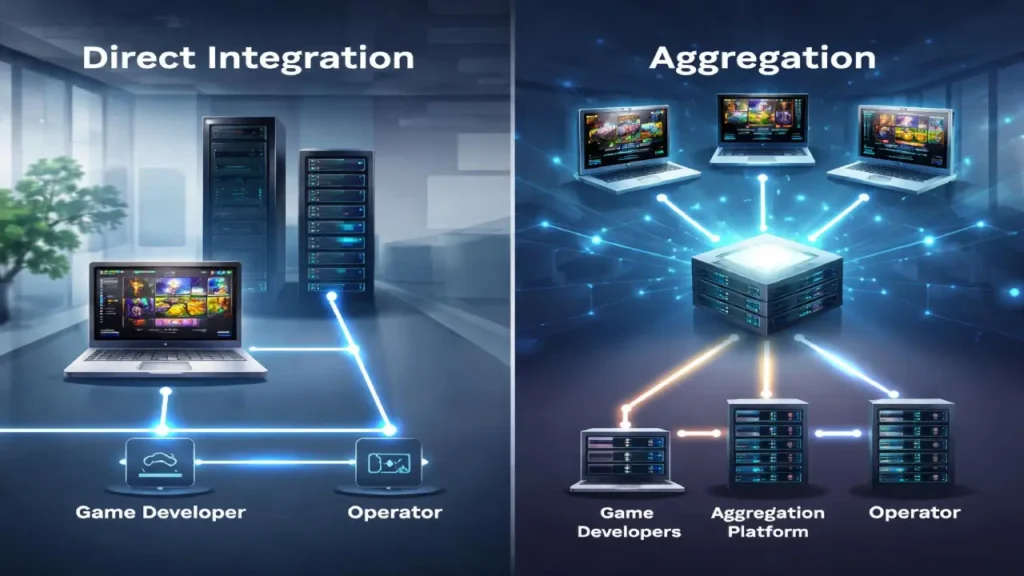
How Games Reach Operators: Direct Integration vs Aggregation
Once a game is built, tested, and certified, it needs to reach the online casino platforms where players can actually play it. This delivery happens through two primary channels: direct integration between the provider and the operator, or indirect delivery through a game aggregator.
Direct integration means the operator builds a technical connection specifically to the provider’s API. This gives the operator maximum control over the integration, including the ability to negotiate custom commercial terms, access exclusive titles, and implement provider-specific features. However, direct integration requires significant technical resources and ongoing maintenance. If an operator wants to offer games from 50 different providers, they would need to build and maintain 50 separate integrations, each with its own technical specifications, update schedules, and support requirements.
Aggregation solves this scalability problem by offering operators a single integration point that connects them to hundreds of providers simultaneously. The aggregator acts as a middleware layer that translates between the operator’s platform and each provider’s API, handling the technical complexity so that the operator only needs to maintain one connection. When the aggregator adds a new provider to its network, all connected operators can access that provider’s games without any additional development work.
The aggregation model has become the dominant delivery method in 2026 because it dramatically reduces time-to-market, lowers technical costs, and allows even small operators to offer game libraries that rival the largest platforms. However, it comes with trade-offs. Aggregators take a revenue share from every bet processed through their platform, which reduces the operator’s margin compared to direct integration. Some exclusive features or promotional tools may only be available through direct integration. And the operator has less control over the technical performance of the connection because the aggregator introduces an additional layer between the game and the platform.
| Delivery Method | Advantages | Disadvantages | Best For |
|---|---|---|---|
| Direct integration | Maximum control, custom terms, exclusive features, higher margins | Expensive to build and maintain, slow to scale | Large operators with dedicated technical teams |
| Single aggregator | Simple integration, fast access to hundreds of providers | Revenue share reduces margins, less control | Small to medium operators seeking fast market entry |
| Multi-aggregator | Broader content access, reduced dependency on one partner | Multiple integrations to maintain, potential content duplication | Medium operators balancing breadth with control |
| Hybrid (direct + aggregator) | Best content from direct deals, breadth from aggregation | Most complex to manage, requires strategic planning | Enterprise operators optimising for both depth and breadth |
The Major Provider Categories and What They Deliver
The casino software provider landscape is not monolithic. Different companies specialise in different categories of content, and understanding these categories helps explain the diversity you see when browsing an online casino’s game library.
Slot-focused studios like Pragmatic Play, Play’n GO, NetEnt, Hacksaw Gaming, Nolimit City, and Push Gaming concentrate primarily on video slot development. These companies invest heavily in visual design, mathematical innovation, and unique bonus mechanics to differentiate their titles in an extremely crowded market. Pragmatic Play alone releases multiple new slot titles every month, using HTML5 technology and a mobile-first development approach that ensures seamless gameplay across all devices. Their games are available in nearly 30 languages and support most currencies worldwide.
Live dealer specialists, led by Evolution Gaming as the dominant global force, focus on streaming technology, studio design, dealer training, and the production of real-time gaming experiences. Evolution’s acquisition strategy has expanded their portfolio to include studios like NetEnt, Red Tiger, Big Time Gaming, Nolimit City, and Ezugi, creating a conglomerate that spans both live and digital content. Their live casino coverage includes roulette, blackjack, baccarat, poker, game shows, and culturally localised games for specific markets.
Full-stack platform providers like SOFTSWISS, EveryMatrix, and Aspire Global deliver not just games but the entire operational infrastructure needed to run an online casino. These companies offer turnkey solutions that include the platform software, game aggregation, payment processing, compliance tools, and back-office management systems, allowing new operators to launch a fully functional casino in weeks rather than months.
| Provider Category | What They Deliver | Leading Examples | Typical Portfolio Size |
|---|---|---|---|
| Slot-focused studios | Video slots with unique themes and mechanics | Pragmatic Play, Play’n GO, NetEnt, Hacksaw Gaming | 100 to 500+ slot titles |
| Live dealer specialists | Real-time streamed table games and game shows | Evolution Gaming, Pragmatic Play Live, Playtech Live | 50 to 200+ live tables |
| Table game developers | Digital versions of classic casino games | Microgaming, Playtech, Red Tiger | 20 to 100+ table titles |
| Crash and instant game studios | Fast-round, simple-mechanic games | Spribe, Turbo Games, SmartSoft | 10 to 50 instant titles |
| Full-stack platform providers | Complete casino infrastructure plus content | SOFTSWISS, EveryMatrix, GammaStack | Platform + aggregated content |
| Niche and regional studios | Market-specific games for local audiences | Various regional developers | 10 to 50 localised titles |
The Technology Behind Modern Game Delivery
The technical infrastructure that powers game delivery in 2026 is built on several key technologies that enable the seamless, fast, and reliable experience that players have come to expect.
HTML5 is the universal standard for game development, replacing the Flash technology that dominated the industry’s early years. HTML5 games run natively in web browsers without requiring plugins, downloads, or separate installations. They adapt automatically to different screen sizes, work on every major operating system, and deliver consistent performance across desktop and mobile devices. This cross-platform compatibility eliminates the need for providers to build separate versions of their games for different devices, dramatically reducing development costs and time-to-market.
Modern platforms are built on modular architecture that allows operators to activate only the components they need. Game aggregators, payment processors, compliance modules, risk management tools, and player engagement systems all function as independent modules that connect through standardised APIs. This modularity means that operators can add or remove capabilities without affecting the core system, scale individual components independently based on demand, and upgrade specific modules without requiring a full platform rebuild.
Cloud infrastructure enables the elastic scaling that modern online casinos require. During peak traffic periods, such as major sporting events or holiday promotions, player activity can spike by orders of magnitude. Cloud-based game delivery systems automatically scale to handle these traffic surges, ensuring that game performance remains consistent regardless of how many players are active simultaneously. This is particularly critical for live dealer games, where any latency in the video stream or bet processing can destroy the player experience.
Content delivery networks distribute game assets across geographically dispersed servers to minimise loading times for players worldwide. When you open a slot game, the visual assets, sound files, and game client are served from the CDN node closest to your physical location, ensuring that the game loads in seconds regardless of where the provider’s primary servers are located. This geographic distribution also provides redundancy, ensuring that a server failure in one region does not affect players in other regions.
What Operators Look For When Choosing Providers
The relationship between operators and providers is a B2B commercial partnership, and the factors that operators evaluate when choosing which providers to integrate reveal important insights about what drives game quality and availability on the platforms you use.
Game quality and player appeal are the most obvious criteria, but they are evaluated through data rather than subjective opinion. Operators analyse provider performance metrics including average revenue per user, player retention rates, session duration, and conversion rates to determine which providers’ games actually engage players and generate revenue. A provider with beautiful games that players abandon after three sessions is less valuable than a provider with simpler-looking games that players return to repeatedly.
Commercial terms determine the financial relationship between the provider and the operator. The standard model is a revenue share where the provider receives a percentage of the net gaming revenue generated by their games, typically ranging from 10 to 25 percent depending on the provider’s market position and the volume of business. Tier-one providers with strong brand recognition and proven player appeal command higher revenue shares, while newer studios may offer more favourable terms to gain market access.
Regulatory coverage determines which markets the provider’s games can legally operate in. A provider that holds certifications for the UK, Malta, Sweden, Denmark, and multiple US states offers significantly more value to an operator with a global footprint than a provider whose games are only certified for a single jurisdiction. The breadth of regulatory coverage reflects the provider’s investment in compliance and testing, which in turn signals the maturity and reliability of their operation.
| Evaluation Criteria | What Operators Assess | Why It Matters |
|---|---|---|
| Game quality and engagement | Player retention data, session metrics, revenue per user | Determines whether games generate sustainable revenue |
| Portfolio breadth and release cadence | Number of titles, frequency of new releases | Keeps the game library fresh and player interest sustained |
| Commercial terms | Revenue share percentage, minimum guarantees, exclusivity | Directly impacts operator profitability |
| Regulatory coverage | Number of jurisdictions with certified games | Determines market availability and compliance risk |
| Technical reliability | Uptime, latency, API stability, update management | Affects player experience and operational confidence |
| Integration complexity | API documentation quality, support responsiveness | Impacts speed and cost of adding the provider to the platform |
| Marketing and promotional support | Branded tournaments, exclusive content, cross-promotion | Helps operators differentiate and attract players |
| Mobile optimisation | Performance on mid-range devices, data efficiency | Critical for mobile-first markets like India |
How Live Dealer Games Are Produced and Delivered
Live dealer games represent a distinct category within the provider ecosystem because they require physical infrastructure, human talent, and broadcast technology in addition to the software development that digital games demand. Understanding how live dealer content is produced and delivered reveals why these games feel so different from their digital counterparts and why a relatively small number of providers dominate this space.
Live dealer games are streamed from purpose-built studios or, in some cases, from actual casino floors. These studios are designed with multiple camera angles, professional lighting, branded table layouts, and sound isolation to create a controlled broadcast environment that maintains consistent quality across thousands of hours of continuous streaming. Evolution Gaming operates studios in multiple countries, employing thousands of trained dealers who work in shifts to provide 24/7 coverage across dozens of simultaneous tables.
The technology stack behind a live dealer game includes high-definition video capture and encoding, optical character recognition that reads physical cards and wheel positions in real time, a game control interface that the dealer uses to manage the betting flow, and a player-facing interface that displays the video feed alongside betting controls and game information. All of these components must work together with sub-second latency to create the seamless, real-time experience that players expect.
Delivery to operators follows the same aggregation model as digital games, but with additional infrastructure requirements. The video stream must be delivered with minimal delay to players worldwide, which requires dedicated streaming servers, adaptive bitrate encoding that adjusts quality based on the player’s connection speed, and CDN distribution that minimises geographic latency. These technical demands explain why live dealer content commands premium pricing and why operators treat live casino as a distinct, high-value category within their overall offering.
The Future of Game Development and Delivery
The game development and delivery ecosystem continues to evolve rapidly, driven by technological innovation, changing player expectations, and regulatory evolution across global markets. Several trends are reshaping how providers build games and how those games reach players.
AI-powered personalisation is enabling providers to create games that adapt in real time to individual player preferences. Rather than delivering the same static experience to every player, AI systems can adjust visual themes, bonus frequency, soundtrack mood, and promotional messaging based on each player’s behavioural profile. This personalisation happens at the platform level rather than within the game itself, but it represents a fundamental shift in how content is curated and presented.
Modular game architecture is allowing providers to build games from reusable components that can be recombined and reconfigured more efficiently. Instead of building every new slot from scratch, studios create libraries of mechanics, visual assets, and mathematical models that can be assembled into new combinations, dramatically reducing development time while maintaining quality and uniqueness.
The convergence of gaming and entertainment is pushing providers to create experiences that blur the line between casino games and broader digital entertainment. Game show formats, narrative-driven slot experiences, social gaming features, and cross-platform integration with streaming and social media platforms represent the frontier of game development, where the goal is not just to offer a bet but to deliver an entertainment experience that competes for attention with Netflix, gaming consoles, and social media.