
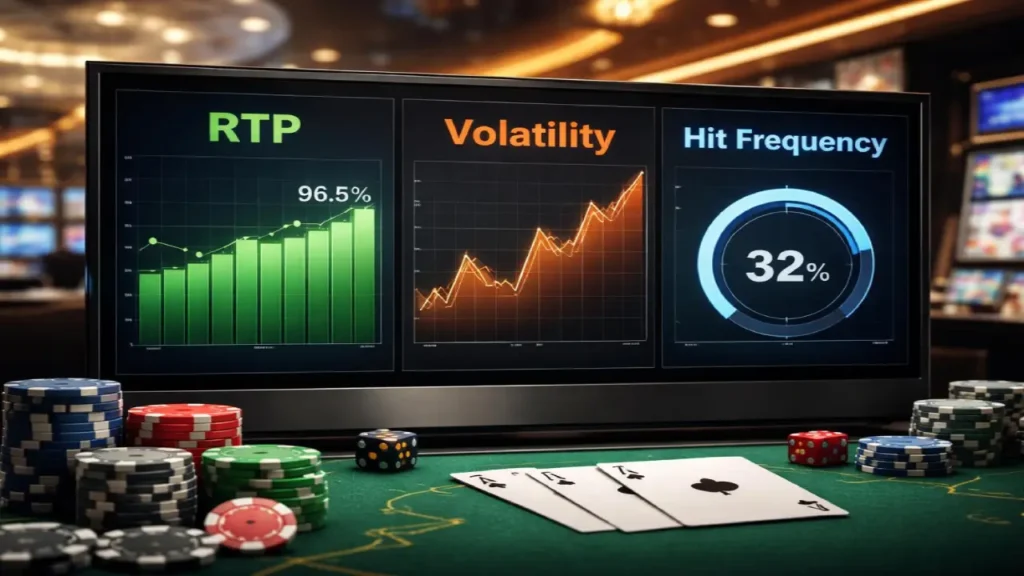
Every casino game you will ever play, whether it is a slot, a table game, a video poker machine, or a live dealer experience, is defined by three fundamental numbers. Return to Player tells you how much money the game gives back over time. Volatility tells you how that money is distributed across your session. Hit frequency tells you how often you can expect to land a winning result. Together, these three metrics form a complete picture of what any game will feel like to play, how fast your bankroll will move in either direction, and whether the experience matches your personal tolerance for risk and reward. Understanding all three, not just one or two in isolation, is the difference between choosing games that genuinely suit you and stumbling into experiences that leave you frustrated, confused, or broke far faster than you expected.
The remarkable thing is that these numbers are publicly available for virtually every legitimate online casino game. They are printed in the help screens, published on provider websites, and listed in game reviews. Yet the overwhelming majority of players never check them. They choose games based on theme, brand recognition, or the size of the advertised jackpot without ever looking at the three metrics that will determine their actual experience. That is like buying a car based on its paint colour without checking the fuel efficiency, the engine power, or the safety rating. The paint colour matters for enjoyment, but the numbers determine whether the vehicle actually gets you where you want to go.
This guide explains each of these three metrics in plain language, shows you how they interact with each other, and gives you the practical knowledge to evaluate any casino game you encounter. By the end, you will never look at a game the same way again.
Return to Player: How Much the Game Gives Back
Return to Player, universally abbreviated as RTP, is the percentage of all wagered money that a game is designed to return to players over its lifetime. If a slot has an RTP of 96%, it means that for every ₹100 wagered across millions of spins by all players combined, ₹96 is returned as winnings and ₹4 is retained by the casino as profit. That ₹4 is the house edge, and RTP is simply the house edge expressed from the player’s side of the equation. RTP plus house edge always equals 100%.
The first and most important thing to understand about RTP is that it is a long-term statistical average, not a prediction of what will happen in your session. A 96% RTP game will not return exactly ₹96 for every ₹100 you personally wager today. In a single session, you might double your money or lose everything. Both outcomes are perfectly consistent with a 96% RTP because the percentage only converges toward its theoretical value over millions of bets across all players. The casino operates on long-term mathematics. You operate on short-term experience. This fundamental difference in time horizon is why RTP can seem misleading if you misunderstand what it actually measures.
RTP varies dramatically across different game types and even between different versions of the same game. The range is enormous, and the financial impact of choosing a high-RTP game over a low-RTP game compounds significantly over time.
| Game Type | Typical RTP Range | House Edge Range | What It Means Practically |
|---|---|---|---|
| Blackjack (basic strategy) | 99.0% to 99.5% | 0.5% to 1.0% | Slowest bankroll erosion, best mathematical value |
| Video poker (Jacks or Better, optimal play) | 98.0% to 99.5% | 0.5% to 2.0% | Near-breakeven with perfect strategy |
| Baccarat (banker bet) | 98.94% | 1.06% | Excellent odds with zero skill required |
| European roulette | 97.3% | 2.7% | Solid value for a pure chance game |
| High-RTP online slots | 96.0% to 98.0% | 2.0% to 4.0% | Best slot value, significantly better than average |
| Average online slots | 94.0% to 96.0% | 4.0% to 6.0% | Industry standard, acceptable for entertainment |
| Low-RTP online slots | 85.0% to 94.0% | 6.0% to 15.0% | Poor value, bankroll drains much faster |
| American roulette | 94.74% | 5.26% | Nearly double the house edge of European version |
| Keno | 75.0% to 80.0% | 20.0% to 25.0% | Worst RTP of any standard casino game |
The difference between playing a 97% RTP slot and an 89% RTP slot is not a minor nuance. If you wager ₹50,000 total during a month of play, the high-RTP game expects to cost you ₹1,500 while the low-RTP game expects to cost you ₹5,500. That is nearly four times more money lost for the exact same amount of entertainment. Checking the RTP before you play takes seconds and is the single highest-leverage decision most casino players can make.
Some providers release their games with multiple RTP configurations, allowing casinos to select which version they offer. This means the same game title can have a 96.5% RTP on one platform and a 94.0% RTP on another. Always check the RTP displayed in the specific game you are playing rather than relying on general information about the title, because the version you encounter may not be the highest one available.
Volatility: How the Money Comes Back
If RTP tells you how much a game returns, volatility tells you how it returns it. This distinction is critical because two games with identical RTPs can create completely different playing experiences depending on how their payouts are distributed. Volatility measures the balance between payout frequency and win size, and it is the primary factor that determines what your session actually feels like from spin to spin and hand to hand.
A low-volatility game distributes its returns in frequent, small payments. You win often, but each win is relatively modest. Your bankroll moves gently, drifting up and down without dramatic swings. Sessions tend to last longer because the steady flow of small wins keeps your balance alive even during periods where you are technically losing ground to the house edge. Low-volatility games are often described as “grinding” experiences where the emotional temperature stays fairly constant throughout.
A high-volatility game concentrates its returns into rare, large payouts. You can go dozens or even hundreds of spins without hitting anything meaningful, and then suddenly land a single result that pays 200x, 500x, or even 1,000x your bet or more. The experience is characterised by long dry stretches punctuated by explosive moments of elation. Your bankroll swings dramatically, and sessions can end very quickly if the big hits do not arrive before your funds run out. High-volatility games demand larger bankrolls relative to bet size because you need enough runway to survive the drought periods and remain in the game when the major payouts finally land.
Medium volatility sits between these extremes, offering a blend of regular smaller wins and occasional larger payouts. Most popular slot games in 2026 fall into the medium to medium-high volatility range because this profile provides enough frequent feedback to keep players engaged while maintaining enough upside potential to create genuinely exciting moments.
| Volatility Level | Win Frequency | Typical Win Size | Session Character | Bankroll Requirement |
|---|---|---|---|---|
| Very Low | Very frequent (40%+ hit rate) | Mostly 1x to 5x bet | Steady, predictable, calm | 50 to 100x bet size |
| Low | Frequent (30% to 40% hit rate) | Mostly 1x to 10x bet | Gentle drift with occasional small spikes | 100 to 150x bet size |
| Medium | Moderate (20% to 30% hit rate) | Mix of small and medium wins | Balanced with noticeable swings | 150 to 250x bet size |
| Medium-High | Less frequent (15% to 25% hit rate) | Occasional large wins mixed with small returns | Periods of drought followed by satisfying payouts | 200 to 300x bet size |
| High | Infrequent (10% to 20% hit rate) | Rare but potentially very large wins | Long dry spells with explosive peaks | 300 to 500x bet size |
| Very High / Extreme | Rare (below 10% hit rate) | Massive potential wins, often 1,000x+ | Brutal dry stretches, life-changing single hits | 500x+ bet size |
Understanding volatility is essential for bankroll management. If you sit down at a high-volatility slot with a bankroll of only 50x your bet size, you are giving yourself a very limited number of spins to hit the game’s major features. Statistically, you are likely to exhaust your funds before the variance works in your favour. Conversely, playing a low-volatility game with a massive bankroll relative to your bet size means you are unlikely to experience the dramatic swings that make the game exciting, and you may find the session monotonous despite being mathematically sound.

Hit Frequency: How Often You Win Anything at All
Hit frequency is the most straightforward of the three metrics but also the most commonly overlooked. It simply measures the percentage of rounds, spins, or hands that produce any winning result at all, regardless of the size of that win. A game with a 30% hit frequency means that roughly 30 out of every 100 spins will return something to you, while 70 will return nothing.
Hit frequency is closely related to volatility but is not the same thing. A game can have a relatively high hit frequency but still be highly volatile if most of its wins are tiny and the majority of its RTP is concentrated in rare bonus features. Conversely, a game with a lower hit frequency might have medium volatility if the wins that do appear are consistently large enough to sustain your bankroll. The relationship between hit frequency, average win size, and the distribution of payouts across base game and bonus features creates the complete volatility profile that defines the playing experience.
For most online slots, hit frequency ranges from roughly 15% to 45%. Low-volatility games tend to cluster at the higher end of this range, hitting on nearly every third spin. High-volatility games often sit below 20%, meaning you can expect long sequences of losing spins between payouts. Table games generally have higher hit frequencies than slots because more outcomes produce some form of return, even if that return is simply getting your bet back in a push scenario.
| Game Type | Typical Hit Frequency | What It Means in Practice |
|---|---|---|
| Low-volatility slots | 35% to 45% | Win something roughly every 2 to 3 spins |
| Medium-volatility slots | 25% to 35% | Win something roughly every 3 to 4 spins |
| High-volatility slots | 15% to 25% | Win something roughly every 4 to 7 spins |
| Very high-volatility slots | Below 15% | Can go 7 to 10+ spins without any win |
| Blackjack | ~43% win, ~9% push | Nearly half of all hands produce a return |
| European roulette (even bets) | ~48.6% | Almost a coin flip on red/black or odd/even |
| Baccarat (banker bet) | ~45.8% | Wins slightly less than half the time |
| Video poker (Jacks or Better) | ~45% | Pair of Jacks or better on nearly half of deals |
Hit frequency matters psychologically as much as mathematically. Human beings are wired to respond to feedback loops, and a game that goes 15 spins without a single win creates a very different emotional experience than one that pays back small amounts every two or three spins, even if both games have the same RTP over the long run. Players who enjoy the thrill of chasing rare big wins will naturally gravitate toward low hit frequency games. Players who find extended losing streaks stressful or demotivating will be happier with high hit frequency games that provide constant positive reinforcement, even when the individual wins are small.
How the Three Metrics Interact With Each Other
The real power of understanding RTP, volatility, and hit frequency comes from seeing how they work together as a system rather than treating each one in isolation. Any single metric tells you something useful, but it is the combination of all three that creates the complete picture of what a game will actually feel like in practice.
Consider two hypothetical slots, both with a 96% RTP. Game A has low volatility with a 40% hit frequency. Game B has very high volatility with a 12% hit frequency. Both return the same amount of money over millions of spins, but the player experience is radically different. Game A feels like a gentle stream where small wins flow constantly and your balance oscillates within a narrow band. Game B feels like a desert hike where you trudge through long stretches of nothing and then suddenly stumble upon an oasis that floods your balance with a massive single payout. Same RTP. Completely different journey.
Now add a third dimension. Game C also has a 96% RTP and high volatility but achieves its hit frequency of 25% by paying back lots of tiny wins in the base game while concentrating its real value in a bonus feature that triggers rarely but pays enormously. Game D has the same overall numbers but distributes its wins more evenly, with moderate base game wins and moderate bonus payouts. Both are high volatility with 96% RTP, but the session experience differs because of where the RTP lives within the game’s structure.
| Game Profile | RTP | Volatility | Hit Frequency | Session Experience |
|---|---|---|---|---|
| Gentle Grinder | 96% | Low | 40% | Steady small wins, slow bankroll erosion, long sessions |
| Balanced All-Rounder | 96% | Medium | 28% | Mix of small and medium wins, moderate swings |
| Bonus Hunter | 96% | High | 22% | Dry base game, explosive bonus rounds, dramatic swings |
| Jackpot Chaser | 96% | Very High | 12% | Brutal dry spells, potential for life-changing single hits |
| Base Game Bleeder | 92% | Medium | 30% | Frequent wins but bankroll drains faster due to lower RTP |
| High-Value Steady | 98% | Low | 38% | Closest to break-even, ideal for bonus clearing |
This framework reveals why simply knowing a game’s RTP is not enough information to make a good decision. A 96% RTP high-volatility slot and a 96% RTP low-volatility slot are fundamentally different products that suit different players, different bankrolls, and different emotional preferences. Choosing between them without understanding their volatility and hit frequency is choosing blindly.
Where to Find These Numbers for Any Game
One of the most common questions players ask is where to actually find the RTP, volatility, and hit frequency for the games they want to play. The good news is that this information is more accessible than ever in 2026, though it does require knowing where to look.
RTP is the most consistently available metric. Most online slot games display their RTP in the game’s information or help section, accessible through a menu icon or question mark button within the game interface itself. Some platforms also publish RTP tables on their websites listing every game in their library. Provider websites like Pragmatic Play, NetEnt, and Play’n GO publish the designed RTP for each of their titles, though remember that the specific casino you play at may be running a different RTP configuration.
Volatility is usually published by the game provider and included in the game’s information screen, often expressed on a scale such as Low, Medium, Medium-High, High, or on a numerical scale of 1 to 5. However, volatility descriptions are less standardised than RTP, and what one provider calls “Medium-High” another might label simply as “High.” Independent slot review sites provide more nuanced volatility assessments based on actual gameplay analysis.
Hit frequency is the hardest of the three to find because not all providers publish it. When it is available, it appears in the game’s technical specifications or in detailed reviews from independent testing sites. Even when the exact percentage is not published, you can infer approximate hit frequency from the volatility rating and your own observation during demo play. A game where you win something on every third spin has roughly a 33% hit frequency, and tracking this during a free play session gives you a practical estimate.
| Metric | Where to Find It | How Reliable Is It | What to Watch Out For |
|---|---|---|---|
| RTP | In-game help screen, provider website, casino info page | Very reliable when sourced from the game itself | Same title may have different RTP on different platforms |
| Volatility | Provider description, game info screen, review sites | Moderately reliable, but definitions vary between providers | Labels like “Medium” are not standardised across the industry |
| Hit frequency | Provider specifications, independent reviews, demo play observation | Less consistently available, sometimes requires estimation | Not all providers publish exact hit frequency numbers |

Matching Game Profiles to Your Playing Style
Armed with an understanding of all three metrics, you can now make game choices that align with your personal preferences, bankroll size, and emotional tolerance for risk. This is not about finding the objectively “best” game, because no such thing exists. It is about finding the game that is best for you, given your specific circumstances and what you want out of the experience.
If you have a smaller bankroll and value extended playing time, look for games with high RTP, low to medium volatility, and high hit frequency. These games keep your balance alive longer, provide consistent feedback through frequent small wins, and erode your bankroll slowly enough that you get maximum entertainment per rupee wagered. This profile is also ideal for clearing wagering requirements on bonuses, where the goal is to churn through a required bet amount with minimal losses.
If you are a thrill seeker with a larger bankroll who plays for the excitement of chasing massive wins, high-volatility games with lower hit frequency are your territory. Accept that most sessions will be losing sessions, ensure your bankroll is large enough to give you a genuine chance of reaching the game’s major features (at least 300 to 500x your bet size), and enjoy the adrenaline of the ride knowing that the mathematical possibility of a career-defining payout exists on every single spin.
If you want a balanced experience that provides both regular engagement and occasional excitement, medium-volatility games with a 25% to 35% hit frequency offer the best of both worlds. You will experience enough wins to stay interested, enough variety in win sizes to keep things unpredictable, and enough bonus features to create genuine memorable moments without the extreme drought periods that high-volatility games demand you endure.
| Your Priority | Ideal RTP | Ideal Volatility | Ideal Hit Frequency | Example Game Profile |
|---|---|---|---|---|
| Longest possible session time | 97%+ | Low | 35%+ | High-RTP, low-volatility grinder |
| Maximum entertainment per rupee | 96%+ | Medium | 25% to 35% | Balanced mid-range slot or table game |
| Chasing big single wins | 95%+ | High to Very High | 15% to 22% | Bonus-heavy high-volatility slot |
| Clearing bonus wagering requirements | 97%+ | Low to Medium | 30%+ | Steady, high-RTP game with minimal variance |
| Social, relaxed play | 95%+ | Low to Medium | 30%+ | Low-pressure game with frequent positive feedback |
| High-stakes adrenaline | Any | Very High | Below 15% | Extreme volatility with jackpot potential |
Common Mistakes Players Make With These Numbers
Even players who are aware of RTP, volatility, and hit frequency frequently make errors in how they apply this knowledge. Understanding the most common mistakes helps you avoid them and make genuinely informed decisions rather than partially informed ones that lead to the wrong conclusions.
The most widespread mistake is focusing exclusively on RTP while ignoring volatility. A player who chooses a 97% RTP game expecting gentle, consistent returns will be shocked and disappointed if that 97% is delivered through a very high-volatility structure where 95% of the RTP lives inside a bonus feature that triggers once every 250 spins. The RTP is excellent, but the experience is brutal for anyone who does not understand what they are walking into.
The second most common mistake is choosing high-volatility games with insufficient bankroll. There is nothing wrong with playing high-volatility slots if you enjoy the experience and understand the risk. But sitting down with 50x your bet size at a game designed to deliver its value in rare 500x explosions is a recipe for rapid elimination. You simply do not have enough spins to give variance a chance to work in your favour.
The third mistake is assuming that hit frequency equals quality. A game with a 40% hit frequency sounds much more generous than one with a 15% hit frequency until you realise that the 40% game might be paying back 0.5x your bet on most of those wins while the 15% game delivers 20x or 50x when it does hit. Frequency without context about win size is incomplete information that can lead you to choose games that feel busy but drain your bankroll just as fast or faster than games that feel quieter.
| Common Mistake | Why Players Make It | Why It Costs Them |
|---|---|---|
| Focusing only on RTP | RTP is the most widely discussed and easiest to understand | Ignoring volatility leads to wrong expectations about session experience |
| Underfunding high-volatility play | Excitement of big-win potential overrides bankroll discipline | Bankroll exhausted before variance has a chance to deliver |
| Equating hit frequency with generosity | More frequent wins feel better psychologically | Tiny frequent wins can mask faster bankroll erosion than rare big wins |
| Ignoring where RTP lives in the game | Assume all wins are distributed evenly | Most RTP may sit in a bonus feature that rarely triggers |
| Not checking RTP on the specific platform | Assume all versions of a game have the same RTP | May unknowingly play a reduced-RTP version |
| Chasing losses on high-volatility games | Believe a big win is “due” after a losing streak | Each spin is independent, past losses do not influence future outcomes |
Applying These Metrics Beyond Slots
While RTP, volatility, and hit frequency are most commonly discussed in the context of slot games, they apply to every form of casino gaming. Understanding how these metrics manifest in table games, video poker, and live dealer experiences expands your ability to make informed choices across the entire casino floor.
Blackjack with basic strategy has an RTP of approximately 99.5%, very low volatility in standard play, and a hit frequency of roughly 43% when including pushes as neutral outcomes. This makes it one of the most mathematically favourable games in the casino for players who invest the time to learn proper strategy. The experience is characterised by steady, low-amplitude swings where your bankroll moves gently in either direction over extended sessions.
European roulette has an RTP of 97.3% on most bets, low to medium volatility on even-money wagers like red/black, and a hit frequency of approximately 48.6% on those same bets. Volatility increases dramatically when you move to straight-up single number bets, where the hit frequency drops to 2.7% but the payout jumps to 35 to 1. The same roulette wheel offers both a low-volatility and a high-volatility experience depending entirely on which bets you choose.
Baccarat’s banker bet combines a 98.94% RTP with medium-low volatility and a 45.8% win frequency, making it one of the most efficient simple bets in the casino. The player bet is slightly worse at 98.76% RTP, and the tie bet drops dramatically to around 85.6% RTP with very high volatility, illustrating how different bets within the same game can have wildly different metric profiles.
| Casino Game and Bet | RTP | Volatility | Hit Frequency | Overall Assessment |
|---|---|---|---|---|
| Blackjack (basic strategy) | 99.5% | Very Low | ~43% | Best all-round mathematical value |
| European roulette (even money) | 97.3% | Low-Medium | ~48.6% | Simple, accessible, reasonable odds |
| European roulette (straight up) | 97.3% | Very High | ~2.7% | Same RTP, dramatically different experience |
| Baccarat (banker) | 98.94% | Low-Medium | ~45.8% | Excellent simple bet, no skill needed |
| Baccarat (tie) | ~85.6% | Very High | ~9.5% | Terrible RTP despite attractive 8:1 payout |
| Video poker (9/6 Jacks or Better) | 99.5% | Medium | ~45% | Exceptional value with optimal strategy |
| Craps (pass line) | 98.59% | Low | ~49.3% | Near coin-flip frequency with good RTP |