

Searchable.com works with a vocabulary that mixes academic terms, Google product names and vendor metrics. This reference sorts those terms into groups and defines each one from a named source.
Definitions come from official documentation, the original research paper and Searchable’s own blog. Where a term is a vendor metric rather than an industry standard, the entry says so.
Seven Core Terms in One Table
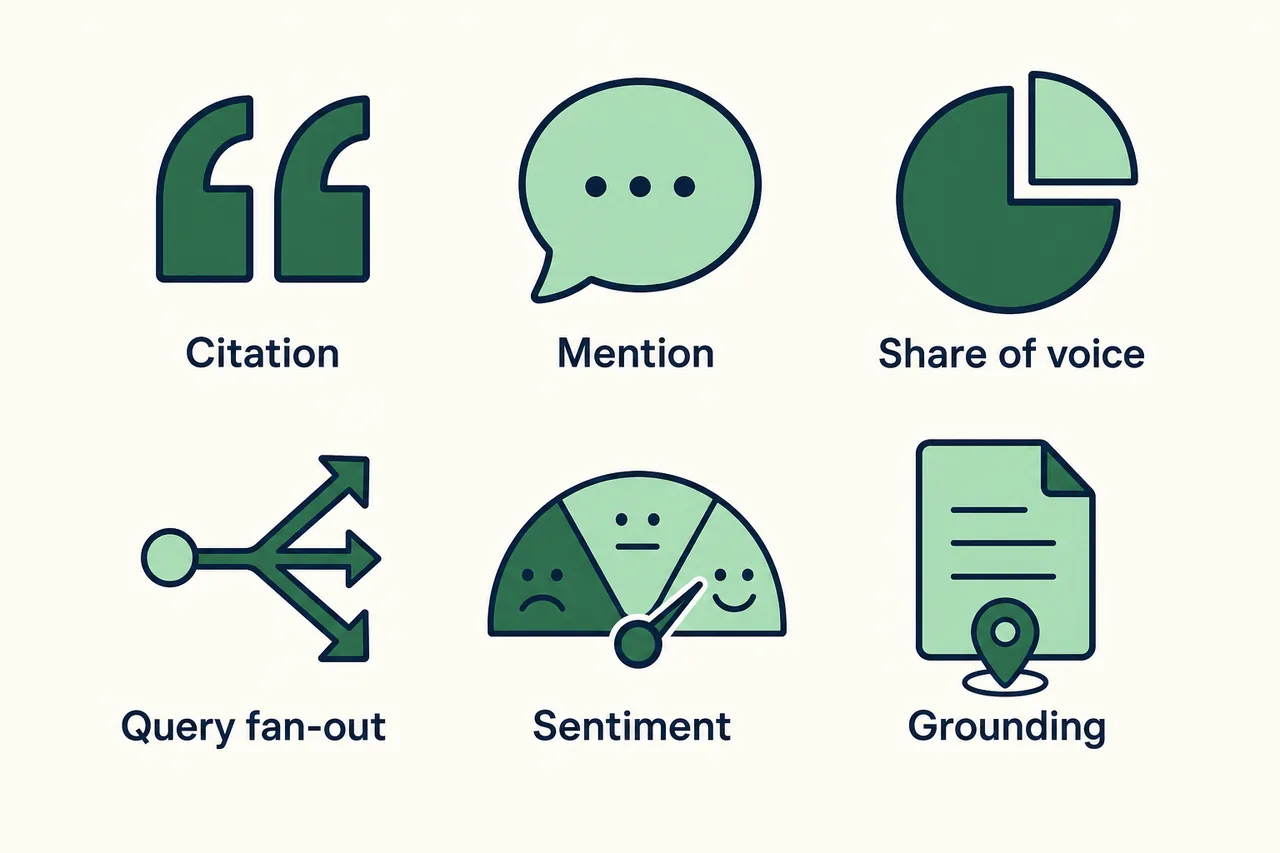
| Term | Short definition | Source |
|---|---|---|
| Generative Engine Optimization (GEO) | Methods for improving how content appears in answers written by generative engines | Aggarwal et al., KDD 2024 |
| Answer Engine Optimization (AEO) | Structuring content so AI answer engines can find, understand and cite it | Searchable blog |
| Search engine optimization (SEO) | Work aimed at ranked links in traditional search results | Contrasted with GEO and AEO in a Searchable article |
| AI Overviews | AI-generated summaries that appear automatically in Google results | Google; Searchable blog |
| AI Mode | Google’s opt-in, chat-style search | Google; Searchable blog |
| Query fan-out | Breaking one question into subtopics that are searched separately | Google; Searchable blog |
| Retrieval-augmented generation (RAG) | Retrieving live pages at answer time and writing the answer from them | Searchable blog |
The sections below expand the terms that need more than a line, then cover metric names, crawler names and the pairs most often confused.
How Searchable.com Defines AEO
Searchable’s article “What is AEO”, published 28 July 2026, defines it as “the practice of structuring your content so that AI answer engines like ChatGPT, Perplexity, and Google’s AI Overviews can find, understand, and cite it”.
The four citation factors
The same article names four factors that shape whether content gets cited.
- Extractability, or how easily a passage can be lifted whole into an answer
- Corroboration, or whether other sources say the same thing
- Entities, or consistent information about who and what a brand is
- Freshness and authority
AEO score as a product term
Searchable also uses AEO scoring as a product feature. Its home page FAQ lists it with content optimization tools, technical site audits and real-time tracking. That score is the company’s own measure, not an industry standard.
Tip. When any vendor quotes an “AEO score”, ask what goes into it. Two scores with the same name from different tools need not measure the same thing.
GEO Began as a Research Term
Generative Engine Optimization was introduced in a paper by Aggarwal et al., presented at KDD 2024. The paper also introduced GEO-bench, a benchmark for testing methods, and reported that methods could boost visibility “up to 40%”, with effectiveness varying by domain.
Note. The 40% figure comes from the paper’s benchmark tests. It is not a forecast for any particular site.
Searchable’s article comparing GEO, SEO and AEO adds a practical point. GEO results are measured probabilistically, through iterative testing, rather than read off a fixed position.
Query Fan-Out Turns One Question Into Several Searches
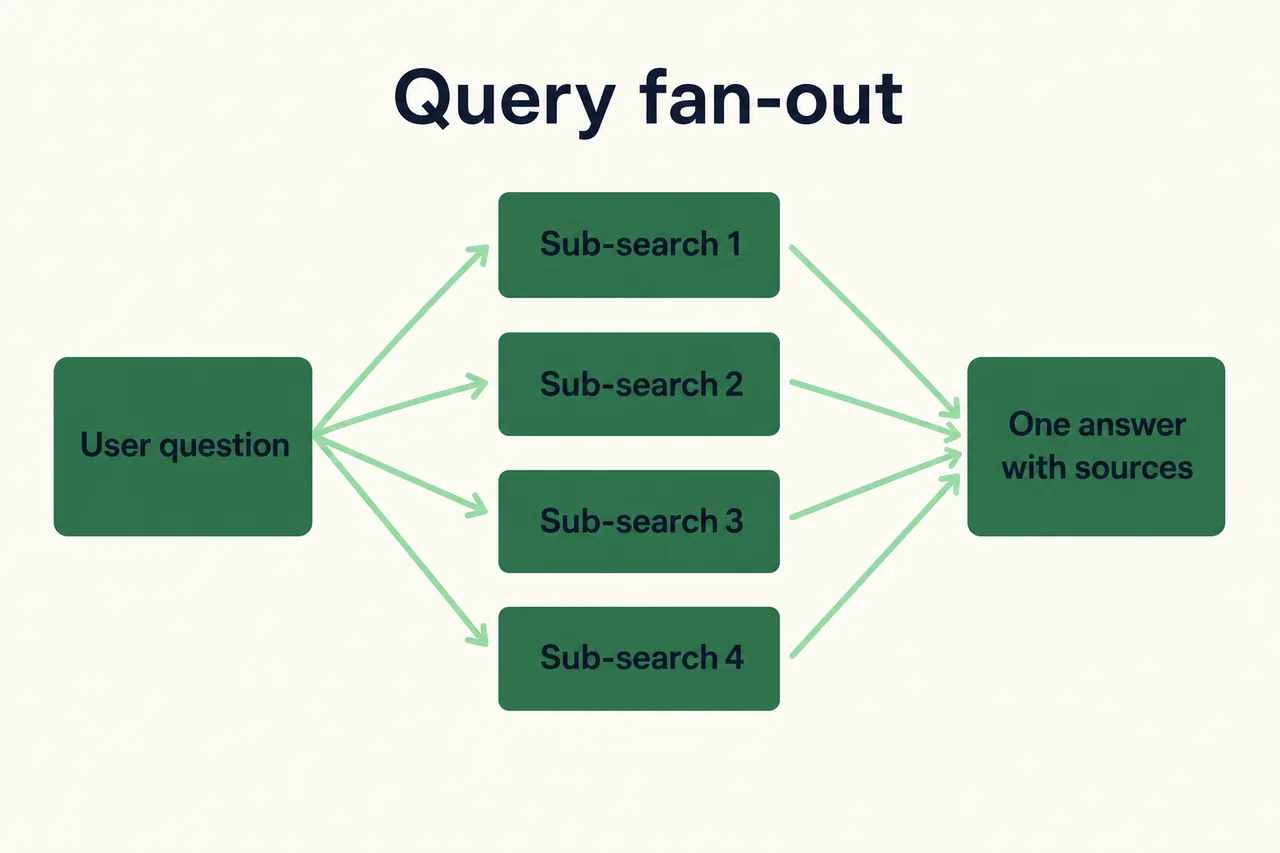
Google’s AI features documentation says AI Overviews and AI Mode may use “query fan-out”. Searchable’s article on AI Mode describes it as breaking a question into subtopics.
An illustrative fan-out
The breakdown below is illustrative only and is not taken from any engine’s logs. A question such as “which CRM suits a ten-person agency” might be split along these lines.
- Which CRM features small agencies need
- Pricing for small teams
- Reviews from agencies of a similar size
- Integrations with common agency tools
- Comparisons between the leading options
What fan-out means for visibility
A page can be cited for one subtopic without ranking for the original question. That helps explain why a page’s rank for the full query is an imperfect guide to whether it gets cited.
Example. Illustrative. A pricing page that never ranks for the broad CRM question could still be cited when the engine searches the pricing subtopic.
Metric Names Used by AI Visibility Tools
These terms appear on Searchable’s product pages and blog. Most are vendor metrics, so definitions can vary between tools. The table uses Searchable’s descriptions.
| Term | Meaning in Searchable’s usage |
|---|---|
| Visibility score | A per-prompt measure of how present a brand is in answers |
| Visibility frequency | How often a brand appears across 60-100+ prompt runs |
| Share of voice | A brand’s presence in answers relative to competitors |
| Average position | Where a brand tends to appear when it is named |
| Citation rate | How often answers cite a brand’s pages |
| Ghost citation | A link to a brand’s site in an answer that never mentions the brand name |
| Sentiment | The tone engines use when describing a brand, measured across many prompts |
| Platform coverage | Which engines mention the brand |
A scoring detail worth knowing
Searchable’s article on brand sentiment scores positive mentions as full, neutral as half and negative as zero. Under that scheme a neutral description still counts for something.
Caveat. Searchable’s tracking article says AI answers have no fixed positions, so “average position” describes a tendency, not a rank.
Crawler and File Names That Come Up in the Same Conversations
These names appear whenever AI visibility is discussed. Configuring them is a technical subject in its own right, so here they are only defined.
- GPTBot crawls for OpenAI model training, and OpenAI says disallowing it is independent of search.
- OAI-SearchBot surfaces sites in ChatGPT search.
- ChatGPT-User covers user-initiated requests.
- PerplexityBot surfaces and links sites in Perplexity results and is not used for foundation model training.
- ClaudeBot, Claude-User and Claude-SearchBot are Anthropic’s agents for training, user requests and search quality.
- llms.txt is a proposed markdown file at /llms.txt, put forward by Jeremy Howard on 3 September 2024 to help agents use a site.
Two related notes from Searchable. Its LLM Analytics feature reports AI crawler activity and bot types and is marked beta, and its AI Overviews article says llms.txt is not needed for AI Overviews.
Content and Source Terms Found in AI Search Guidance
A further set of terms comes from Google’s guidance, Bing’s documentation and Searchable’s articles on content. They describe pages and sources rather than metrics.
- Non-commodity content is content that is unique rather than interchangeable, the focus John Mueller advised on Google’s Search Central blog in May 2025.
- Self-contained section is Searchable’s phrase for a section that answers its own heading, with the answer in the first sentence.
- Chunking means splitting content into small retrievable pieces. Searchable’s AI Overviews article says it is not needed for AI Overviews.
- Information gap is how Searchable’s sentiment article explains many negative descriptions. Its most common negative word, “limited”, appeared for 898 brands.
- Trust chain is a Searchable article’s sequence of backlinks, then rankings, then citation eligibility, then brand authority.
- Grounding queries is a metric name in Bing Webmaster Tools’ AI Performance report, listed beside Total Citations and Average Cited Pages.
- Scaled content abuse is a Google spam policy term. Google’s guidance says generating many pages without adding value may violate it.
Pairs of Terms That Are Easy to Mix Up
Several terms sound interchangeable but are not. These pairs cause the most confusion in briefs and reports.
| Pair | The difference |
|---|---|
| AEO and GEO | AEO, as Searchable defines it, centres on being found and cited by answer engines; GEO comes from research and is measured probabilistically through testing |
| AI Overviews and AI Mode | AI Overviews appear automatically; AI Mode is opt-in chat search |
| Training data and live search | Training data has a cutoff; live search retrieves pages at answer time |
| Tracking and research | Tracking follows known prompts; research discovers new questions |
| Citation and mention | A citation links to a source; a mention names the brand; a ghost citation is the first without the second |
| Branded and unbranded prompts | Branded prompts name the brand; unbranded prompts ask about a category or problem |
Using This Vocabulary Without Overstating It
A shared vocabulary helps teams brief writers and read dashboards, but it can also make vendor metrics sound more settled than they are. Visibility score, AEO score and share of voice are defined by whichever tool reports them, Searchable included.
The steadier terms are the ones with official owners, such as Google’s descriptions of AI Overviews, AI Mode and query fan-out, and the crawler names published by OpenAI, Perplexity and Anthropic. When a Searchable.com dashboard and an official document seem to disagree on a word, the document defines it and the dashboard measures it.