

Ethereum keeps drawing new capital from retail participants who prefer patience over prediction. Instead of guessing where the market turns next, a growing share of American holders let their exchange do the routine work for them. Binance.us packages this behavior inside a feature called Auto Buy, and the mechanic behind it is disarmingly simple: pick an amount, pick a rhythm, and the platform executes the order on your behalf until you tell it otherwise.
This guide unpacks the mechanics of scheduled ETH buys on Binance.us, walks through the setup path, and explains why the tool has become a staple among market participants who care more about accumulation than adrenaline.
What Auto Buy Actually Does on Binance.us
Auto Buy is Binance.us’s native scheduling engine. Once configured, it drafts funds from a linked bank account, debit card, or in-platform USD balance and converts them into the digital asset of your choice at the interval you selected. Ethereum is one of the headline pairs supported by the tool, which pairs neatly with the fact that ETH remains the second-largest cryptocurrency by market capitalization.
The feature sits inside the Buy Crypto menu on both the web dashboard and the mobile application. A single order can be tied to a specific date, a weekday, a payday schedule, or a month-end anchor. Cancellation is possible at any point, and edits to the frequency or the funded amount take effect from the next scheduled cycle.
Why Scheduling Beats Timing
Chasing the bottom of a chart rarely ends the way retail traders hope. Studies on consumer investment behavior repeatedly show that discretionary market timing underperforms disciplined, calendar-based accumulation over multi-year horizons. Auto Buy removes the emotional decision loop from the equation, which is arguably its most valuable contribution.
Setting Up a Scheduled ETH Purchase Step by Step
The setup flow takes fewer than three minutes if your account is already verified and funded. Below is the standard sequence a user encounters on the current interface.
The Account Prerequisites
Before creating a schedule, the profile must clear identity verification and have at least one payment method attached. Bank accounts linked through ACH generally produce the cleanest experience because they carry lower processing fees than debit-card rails. Debit purchases settle faster but are billed at a higher rate, and USD balances funded through wire transfer sit ready for instant conversion.
Building the Order
Inside the Auto Buy panel, choose ETH from the asset selector, then define the dollar amount you want to spend each cycle. Frequency options currently range from daily runs to monthly commitments. A confirmation screen displays the fee, the estimated ETH received based on live pricing, and the exact next-execution timestamp.
Managing Active Schedules
Active recurring orders appear in a dedicated ledger. Users can pause a plan, alter the funded amount, change the payment source, or terminate the arrangement entirely without penalty. A short cooling window applies to newly created orders on some payment methods.
Frequency Menu and Suggested Cadence

Selecting the correct rhythm depends on cash flow patterns and personal risk appetite. The following table summarizes each supported interval alongside a practical use case.
| Frequency | Typical Fit | Behavioral Advantage |
|---|---|---|
| Daily | Small-ticket accumulators tracking short-term volatility | Averages entry price across intraday swings |
| Weekly | Salary earners paid biweekly who want more granularity | Balances execution smoothing with fewer touchpoints |
| Biweekly | Payroll-aligned buyers who batch expenses with income | Syncs crypto contributions with paycheck arrival |
| Monthly | Long-horizon holders treating ETH as a savings vehicle | Minimizes cognitive load and administrative noise |
Each cadence produces the same underlying result across long time frames: a blended cost basis that reflects the average market price rather than a single decision point.
Costs, Limits, and Payment Methods
Fees on scheduled ETH orders mirror the standard Buy Crypto rates on Binance.us. The exact rate depends on the funding source and any promotional tiers active on the account at the moment of execution.
| Payment Rail | Speed | Fee Character | Best Use |
|---|---|---|---|
| ACH Bank Transfer | Standard settlement | Low | Consistent long-run cost efficiency |
| Debit Card | Instant | Higher | One-off top-ups or urgent buys |
| USD Wallet Balance | Instant | Lowest | Pre-funded systematic accumulation |
| Wire Transfer | Same or next business day | Transfer fee only | Large lump sums funding future recurring orders |
Minimum purchase amounts start around a single dollar on select trading pairs, a threshold Binance.us lowered specifically to widen access for smaller-ticket participants. Ceiling limits scale with the account’s verification tier and monthly volume history.
Why Recurring Buys Reward Market Players
The advantages of scheduled purchases stretch beyond convenience. They touch behavior, taxation, mental bandwidth, and long-term portfolio construction. Participants who commit to a recurring plan report calmer engagement with market swings, which is measurable in the reduced churn of their trading history.
Smoothing Out Ethereum’s Price Swings
ETH remains a volatile asset. Weekly drawdowns of ten percent are not unusual, and rallies of comparable magnitude follow with equal frequency. A recurring order fragments the entry into dozens of tickets across every regime, which mathematically pulls the buyer’s average cost toward the mean rather than pinning it to a single emotional moment.
Cutting the Cognitive Load
Manual trading demands constant screen time. A schedule offloads that duty to code, freeing the participant to focus on employment, family, or independent research. This distinction matters more than most newcomers realize because attention itself is a scarce resource in a market that never sleeps.
Encouraging Disciplined Wealth Building
Traditional finance long ago normalized automatic contributions to retirement accounts because the model works. Crypto participants who mirror that structure inherit the same discipline: contributions arrive whether the market is euphoric or bleeding, and the accumulated position compounds without requiring willpower at each decision point.
Reducing the Tax Reporting Headache
Every trade in the United States is a taxable event. Scheduled orders create a clean, uniform paper trail with predictable timestamps, which cost-basis software processes more efficiently than a scatter of impulsive trades. Users still owe capital gains upon disposal, but the reporting itself is streamlined.
Comparing Recurring Purchases Against Lump-Sum Buying
Neither approach is universally superior. The right choice depends on capital availability, personality, and outlook. The table below contrasts the two methods across the dimensions that matter most to individual holders.
| Dimension | Recurring Buys | Lump-Sum Buys |
|---|---|---|
| Timing Risk | Distributed across market conditions | Concentrated on a single day |
| Emotional Pressure | Minimal, decisions are prewired | High, second-guessing is common |
| Fee Aggregate | Slightly higher due to per-order costs | Lower, one execution |
| Suitability | Salaried earners, cautious accumulators | Traders confident in a specific entry |
| Historical Return Edge | Steadier, lower variance | Higher when timing is correct, worse when wrong |
Academic literature published across major financial journals continues to find that lump-sum investing edges recurring contributions in about two-thirds of historical windows for equities. Ethereum, being younger and more volatile, does not have the same length of data set, and its price behavior often rewards the risk-managed approach that recurring buys embody.
Common Mistakes to Sidestep
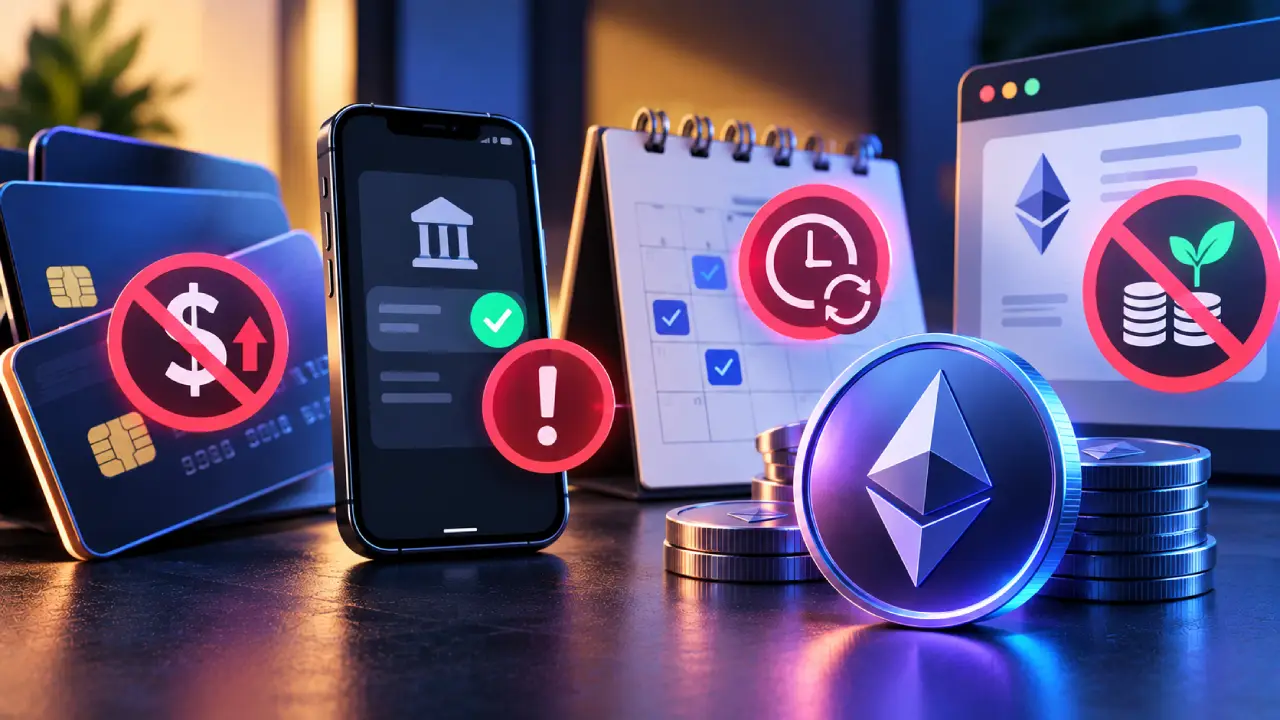
Even a straightforward tool invites errors when users move too quickly. A few pitfalls surface often enough to warrant explicit mention.
Overfunding a Debit Card Schedule
Debit rails carry higher fees. Running an aggressive daily plan through a card can quietly erode the very averaging benefit the schedule was designed to deliver. A quick swap to ACH restores efficiency.
Ignoring the Payment Method Balance
Failed executions frustrate long-term compounding. Keeping the funding source topped up ensures that no scheduled ticket is skipped when the market presents an opportunity to buy lower.
Setting and Forgetting Forever
Automation is powerful, but life circumstances change. Reviewing the plan quarterly guarantees that the contribution size still fits current income, expenses, and risk appetite.
Confusing Scheduled Buys with Staking
Auto Buy purchases ETH into a spot balance. Earning yield on that balance requires a separate action within the platform’s staking or earn products. Newcomers occasionally assume both happen automatically, which is not the case.
Security Considerations for Automated Orders
Scheduled orders inherit the security posture of the account they run inside. Enabling two-factor authentication through an authenticator application rather than SMS remains the single largest defensive upgrade a user can make. Withdrawal address whitelisting, session timeout tightening, and periodic API key audits round out the practical checklist for participants who plan to leave a schedule running for months at a time.
Cold storage of accumulated ETH is a natural next step once the position reaches a size worth protecting off-exchange. Moving balances at regular intervals to a self-custodied wallet keeps the recurring purchase engine humming while limiting exposure on the venue itself.
Taxation Notes for United States Participants
Every scheduled purchase counts as an acquisition. When those coins are eventually sold, swapped, or spent, a taxable event occurs, and the cost basis of each acquisition matters. Detailed record-keeping is legally required, and Binance.us provides downloadable transaction histories that can be uploaded into most tax software. Consulting a certified public accountant familiar with digital assets remains the prudent path for anyone accumulating meaningful sums.
The nature of automated buying makes the record-keeping process almost self-organizing, which is another quiet advantage. A single CSV export can populate an entire year of contributions inside a tax platform without manual reconciliation.
Who Benefits Most from This Approach
Certain profiles align particularly well with scheduled ETH accumulation. Salaried professionals who lack the time to monitor charts find automation liberating. First-time crypto holders often adopt the approach because it converts an intimidating asset class into a familiar contribution pattern. Long-horizon believers in Ethereum’s technical trajectory embrace it as a way to build exposure without concentrating conviction into a single trade. Even seasoned traders occasionally deploy a small recurring plan alongside active positions to guarantee they never miss a bull run entirely due to overthinking.
The common thread is patience. Recurring buys reward those who let time do the compounding rather than expecting each individual purchase to be a masterpiece of timing.
Final Thoughts on Scheduled ETH Accumulation
Binance.us’s Auto Buy engine turns a complex behavioral challenge into a set-and-review workflow. The mechanics are simple, the fee structure is transparent, and the psychological benefits are backed by decades of evidence from the broader investment world. Ethereum’s role in the digital asset landscape continues to expand, and participants who quietly stack the asset month after month position themselves to benefit from that expansion without needing to predict its exact contours.
Whether the goal is a modest side allocation or a serious long-term stake, scheduling the process removes friction, dampens emotion, and lets the market itself average out the cost of participation. That combination is why the feature has become a quietly indispensable tool for American ETH accumulators.